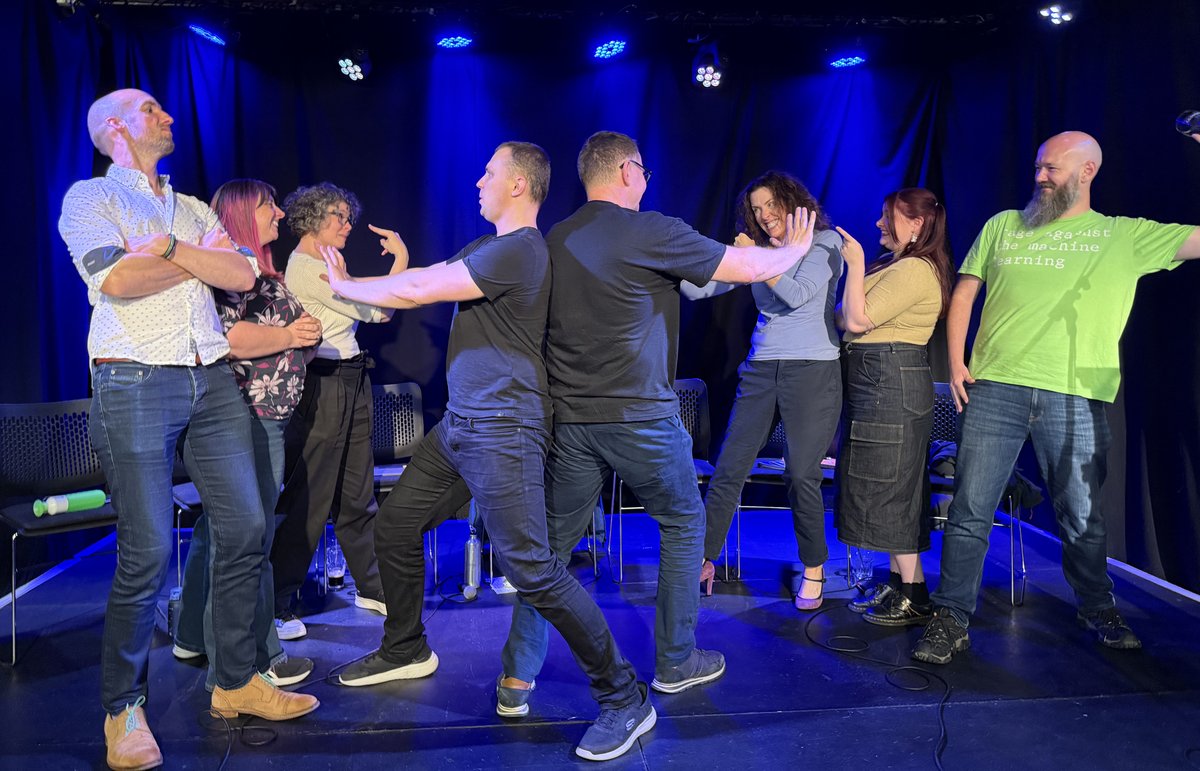
Notes from "Will GenAI Revolutionise our Lives for the Good?"

I was fortunate enough to be invited to participate in a debate raising money for Farset Labs, a cause obviously close to my cold cynical heart. Will GenAI Revolutionise Our Lives For The Good In The Next 5 Years is top tier troll-bait from Garth and Art, and I’m very grateful to have shared the stage with the 5 other speakers. Even the lanky english one. I was particularly impressed by my teammates in their very human-led approach to this question (although everyone was great!) ...

August 8, 2025 · Andrew Bolster

Being a DORC in the age of Generative AI

Lots of people have written about the impact of generative AI on the world of software engineering, and while I write this I’m fighting with CoPilot to stop filling out the rest of the sentence. Gimme a second… … That’s better. Anyway. This is just a blurb/brain-dump of a shower-thought. Don’t come to me for deep insightful stuff about the productivity gains about Generative AI in Software Development, or whether it will be the end of ‘Juniors’ in software engineering, or how we’re going to grow juniors in future. ...

July 14, 2025 · Andrew Bolster

AIOps Maturity Model

Introduction This document outlines an AIOps Maturity Model to help organizations assess and improve their Machine Learning Operations capabilities. It came from my own frustration that there weren’t any models that fit the real experience of end-to-end data science and operations relationships that covered both ‘conventional’ ML, and practically discussing LLM based systems and how completly differently you have to think about them. This was originally published internally around May ‘24 and then presented at NIDC as an ‘Eye Test Model’, and I promised that I’d eventualy publish it; this is it, dusted off and tidied up for public consumption. ...

March 15, 2025 · Andrew Bolster

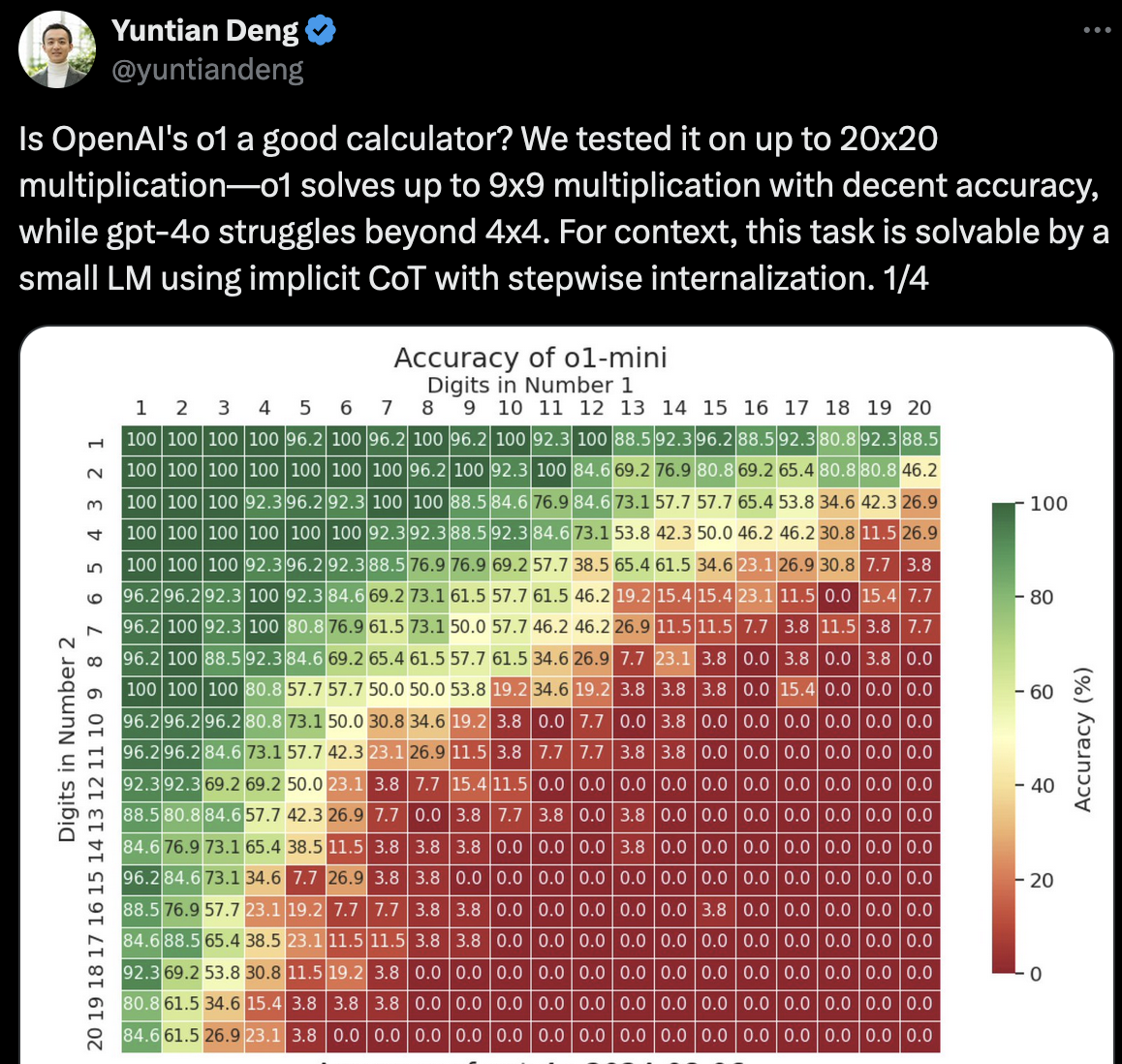
On OpenAI o1

Is LLM Smarter than a 12 year old? Had a few people ask about the o1 models; at work we’ve requested preview access from Microsoft to get them added to our internal LLM Gateway, so we’ll just wait and see, but there’s been some interesting discourse on it so far. My 2c is that this is OpenAI trying to take the chain-of-thought (aka ’talking to yourself’) in house rather than people doing the intermediate steps themselves. (That means, instead of just running the token prediction, it’s a repeated conversation with itself, with OpenAI providing the ‘inner monologe’ and just magically popping out the answer). This is fine in principal, and is how we do multi-shot RAG among other things, but the two(three) critical parts of this for me are ...

September 22, 2024 · Andrew Bolster

"Context all the way down": Primer on methods of Experience injection for LLMs

Much hay has been made that LLM’s can be infinitely trained on infinite data to do infinite jobs, in an approach generally described as ‘LLM Maximalism’. This post is a bit of a braindump to explain my thought process in how to practically use LLMs in a safe way in production/client facing environments, with a little bit of a discussion as to where I see the current blockers to this in most organisations, and where organisations should be focusing investment to be able to meet these challenges without loosing their competitive edge/expertise. ...

April 29, 2024 · Andrew Bolster

Generative AI: Impact on Software Development and Security

This was a piece written as part of my work at Synopsys SIG and was published in a few places, but I liked it and wanted to keep it… At least until the lawyers chase me down. Since the release of ChatGPT, the technology industry has been scrambling to establish and operationalise the practical implications of these human-level conversational interfaces. Now, almost every major organisation is connecting their internal or product documentation to a large language model (LLM) to enable rapid question-answering, and some are starting to wade into the use of generative AI systems to aid in the design and creation of new technical solutions, be it in marketing content, web application code or chip design. But the hype has had its sharp edges as well; the word ‘hallucination’ is never far from the lips of anyone discussing chatbots, and the assumptions that people have around human-like language being equivalent to ‘common sense’ have been seriously challenged. Potential users of LLM derived systems would be wise to take an optimistic but pragmatic approach. The release of the first major public Large Language Model (LLM) set off successive waves of amazement, intrigue and often, fear, on the part of a public unprepared for the surprisingly ‘human’ behaviour of this ‘chatbot’. It appeared to communicate with intentionality, with consideration, and with a distinctively ‘natural human’ voice. Over successive chat-enquiries, it was able to ‘remember’ its own answers to previous questions, enabling users to build up coherent and seemingly complex conversations, and to attempt to answer surprisingly ‘deep’ questions. Yet, these systems should be treated as one would treat a child savant; it might know all the right words in the right order but may not really have the experience or critical thinking to evaluate its own view of the world; the outputs of these systems have not ‘earned’ our institutional trust, and care must be taken in leveraging these systems without significant oversight. ...
February 19, 2024 · Andrew Bolster

Generative Adversarial Procrastination

TL:DR “Don’t worry about being a procrastinator, just make sure that your procrastinations are worthwhile.” There’s an implicit irony in this post that I’ve been thinking / talking about writing it for at least 6 months, and it finally came down to a tweet to force me to do it. Fun fact, in the time it took for me to write this procrastination post, the twitter poll changed, so I guess I gotta delete it all and play Satisfactory now? ...

November 26, 2021 · Andrew Bolster

Dr StrangeBot: Or How I Learned to Stop Worrying and Trust Machine Learning

This post was originally published as part of my role at WhiteHat Security Links have been added for context/comedy/my own entertainment, but no content has been modified Beneath the cynicism, hyperbole, market–making and FUD; the strategic importance of AI in Cybersecurity is only constrained by us ‘meatbags’. Being a data science practitioner in the cybersecurity space has been a double–edged sword for several years. On the one hand, with the proliferation of automated security testing, network IDS advances, the sheer growth in traffic and the threat surface of our increasingly complex, interconnected application development practices, these roiling oceans of flotsam and datum are everything our data hungry little hearts desire. Related innovations in data engineering in the past decade mean that questions that had previously only lived in the craven dreams of executive officers and deranged analysts are now the kind of tasks that we hand off to interns to make sure they have correctly set up their workstations. ...

March 24, 2021 · Andrew Bolster

A Stranger in a Strange Land: Data Science Onboarding In Practice

This talk was originally prepared for the 2020 Northern Ireland Developers Conference, held in lockdown and pre-recorded in the McKee Room in Farset Labs Intro Data Science is the current hotness. While those of us in these virtual rooms may make fun of the likes of Dominic Cummings for extolling a ‘Data Driven Approach’ to policy, the reality is that Data Science as a buzzword bingo term has survived and indeed thrived in a climate where ‘Artificial Intelligence’ is increasingly derided as being something that’s written more in PowerPoint than Python, ‘Machine Learning’ still gives people images of liquid metal exoskeletons crushing powdery puny human skulls, and those in management with long memories remember what kind of mess “Quantitative Analysis” got us into not too long ago… ...

October 20, 2020 · Andrew Bolster

Is Your AI Ethical?

Originally posted in RTInsights Businesses should do their part to ensure products are designed judiciously to reflect core company values and provide audit trails of how AI is learned. As we examine an increasing reliance on artificial intelligence (AI) and machine learning, it’s being revealed that AI can have a built-in bias, whether intentional or not. In late 2019, Apple and Goldman Sachs faced allegations that the Apple Card used an algorithm that discriminated against women in credit-scoring evaluation – after Apple’s own co-founder Steve Wozniak and entrepreneur David Heinemeier Hansson received credit limits of 10-20 times higher than their wives. ...

April 26, 2020 · Andrew Bolster